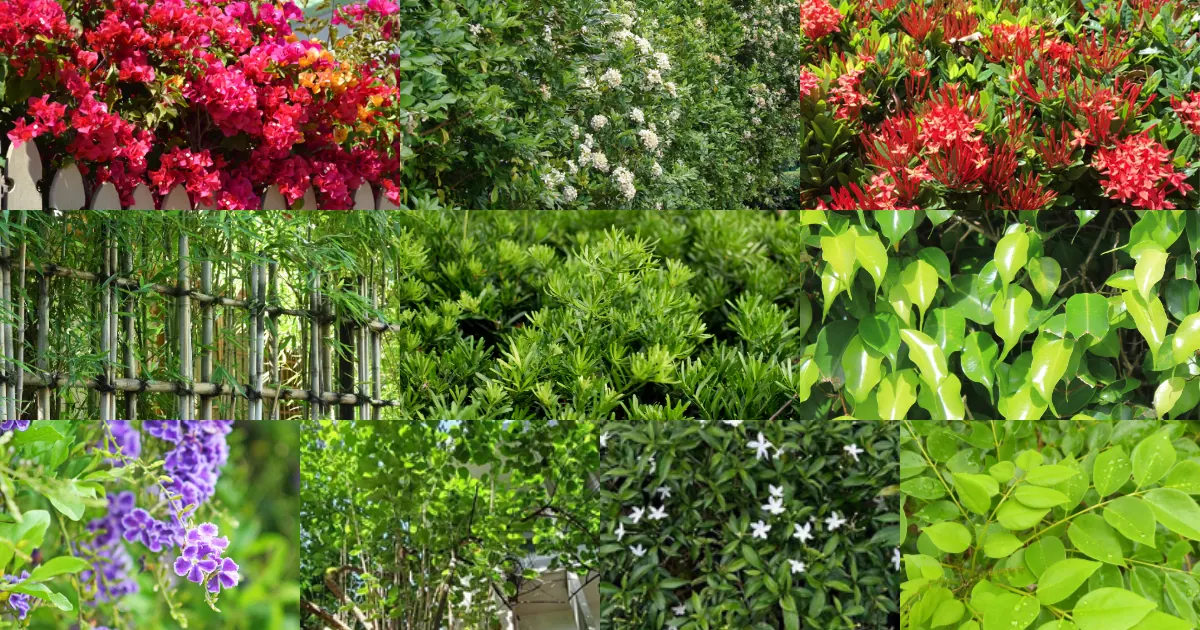
Why Choose a Living Fence in the Philippines
A living fence is more than just a row of plants along your property line. It is a sustainable, affordable, and visually appealing alternative to concrete walls and metal fencing. In the Philippine climate, where year-round warmth and abundant rainfall encourage rapid plant growth, living fences can establish themselves quickly and provide benefits that no manufactured barrier can match.
The advantages of choosing living fence plants in the Philippines over traditional fencing are considerable. A well-maintained green hedge absorbs noise from busy streets, filters dust and air pollution, reduces ambient temperatures by up to 3 to 5 degrees Celsius through transpiration, and creates habitat for beneficial pollinators like butterflies and bees. In cities like Manila, Cebu, and Davao, where lot sizes are shrinking and concrete dominates the landscape, a living fence brings nature back into the neighbourhood.
From a financial perspective, living fences cost significantly less than concrete block walls. A standard concrete perimeter wall runs ₱3,500 to ₱5,000 per linear metre when you factor in materials, labour, and finishing. A living fence using fast-growing species like madre de cacao or duranta can be established for ₱150 to ₱500 per linear metre, depending on plant size and spacing. That represents savings of 70% to 95% compared to masonry.
Living fences also appreciate in value over time rather than depreciating. While a concrete wall cracks and stains within a few years, a well-kept hedge becomes denser, more attractive, and more effective as it matures. If you are planning a garden renovation or building on a new lot, a living fence deserves serious consideration. For more foundational guidance, check out our guide on urban gardening in the Philippines.
Bougainvillea: The Colourful Security Hedge
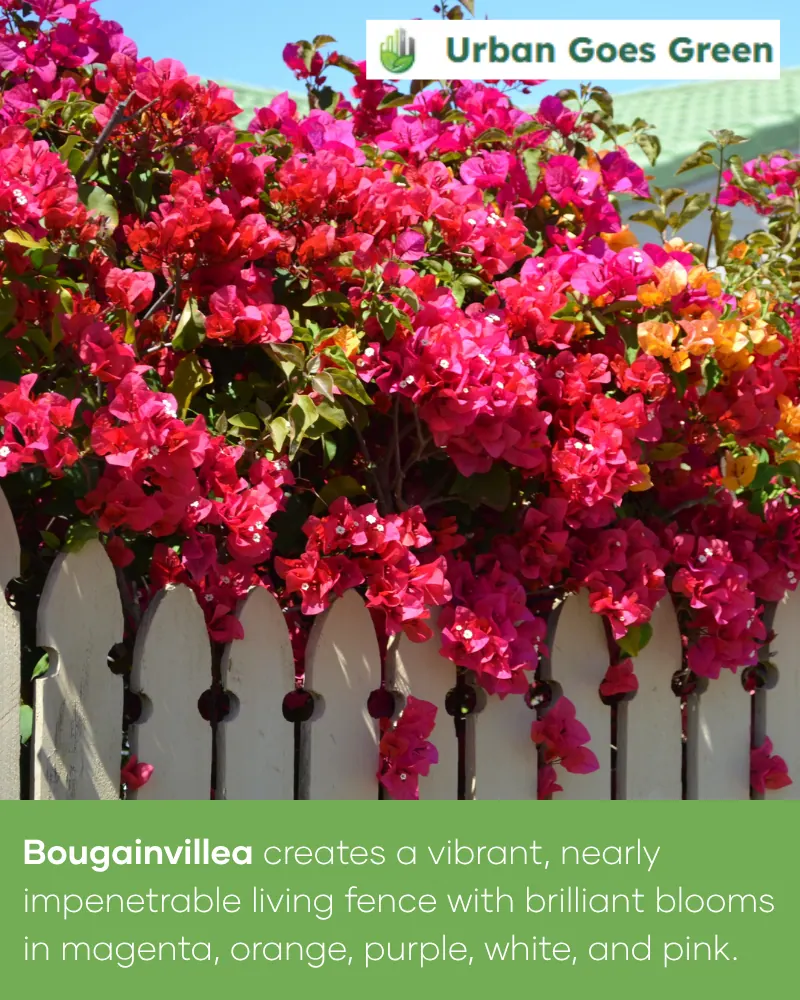
Bougainvillea is arguably the most popular living fence plant in the Philippines, and with good reason. This vigorous tropical vine produces cascades of brilliant colour in shades of magenta, orange, purple, white, and pink. When trained along a fence framework or allowed to grow into a dense shrub form, bougainvillea creates a stunning, nearly impenetrable barrier.
Growth Rate and Size
Bougainvillea grows quickly in Philippine conditions, adding 1 to 1.5 metres of growth per year once established. Mature plants can reach heights of 3 to 5 metres if left unpruned, making them suitable for tall privacy screens. For a standard hedge height of 1.5 to 2 metres, regular pruning keeps them compact and encourages heavier flowering.
Spacing and Planting
Plant bougainvillea at 60 to 90 cm intervals for a dense hedge. Use wider spacing of 1 to 1.2 metres if you want a more relaxed, informal look. Each plant needs a hole approximately 30 cm deep and 30 cm wide, filled with a mix of loam soil and compost. Bougainvillea prefers well-drained soil and does not tolerate waterlogged conditions.
Security Value
The sharp thorns along bougainvillea stems make it an excellent security plant. Once the hedge matures and the branches interweave, it becomes nearly impossible to push through without encountering painful thorns. This makes bougainvillea a top choice for perimeter fencing in residential subdivisions.
Pruning Schedule
Prune bougainvillea every 4 to 6 weeks during the growing season (May to November). After the main flowering flush, cut back the tips by 15 to 20 cm to encourage branching. Wear thick gloves to protect against thorns. A major shaping prune once a year, typically in February or March before the wet season begins, keeps the hedge structured. On long fence lines, a brush cutter with a blade clears weeds along the base much faster than shears.
Cost
Small bougainvillea pots (4 to 6 inches) cost ₱35 to ₱80 each. Larger specimens in 8-inch pots range from ₱150 to ₱300. For a 10-metre fence line at 75 cm spacing, you need about 13 plants, putting your total plant cost between ₱455 and ₱3,900 depending on size.
Bamboo: The Fast-Growing Privacy Screen
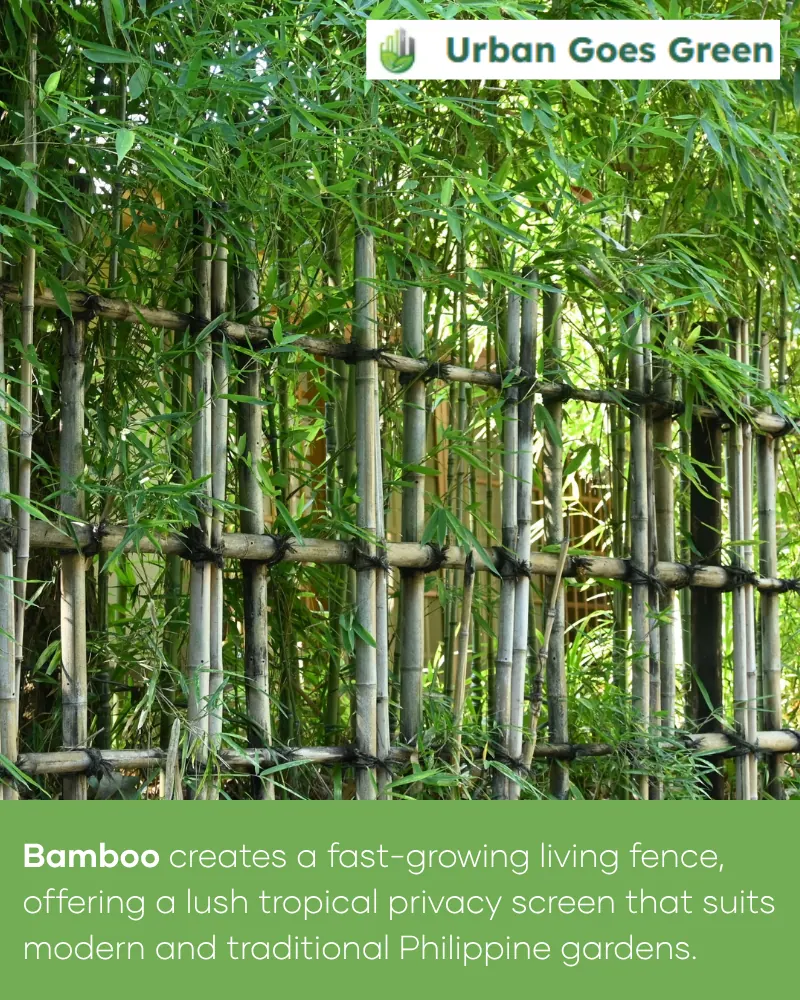
Bamboo is the fastest-growing living fence option available to urban gardeners in the Philippines. Certain species can add 30 to 60 cm of height per week during the wet season, meaning you can have a functional privacy screen within just a few months of planting. The tall, elegant culms create a distinctive tropical aesthetic that works beautifully in both modern and traditional garden designs.
Best Species for Fencing
Not all bamboo species are suitable for hedging. Clumping varieties are strongly recommended over running types, which spread aggressively and can invade neighbouring properties. The best clumping bamboo for Philippine living fences includes:
- Bambusa multiplex (Hedge Bamboo) grows to 3 to 5 metres and forms tight, manageable clumps. This is the most popular choice for residential hedges.
- Bambusa textilis (Weaver's Bamboo) reaches 8 to 12 metres and is ideal for tall windbreaks and large property boundaries.
- Thyrsostachys siamensis (Monastery Bamboo) grows to 6 to 8 metres with graceful, arching culms that create an elegant screen.
Spacing and Growth
Plant clumping bamboo at 1.5 to 2 metre intervals. Each clump will expand by 10 to 15 cm per year, and within 2 to 3 years the clumps will merge to form a continuous screen. Install a root barrier of thick plastic sheeting (at least 60 cm deep) if you want to prevent the clumps from spreading into garden beds or paved areas.
Cost
Bamboo seedlings in 6-inch pots cost ₱80 to ₱200 each. Larger divisions from established clumps run ₱300 to ₱800. For a 10-metre fence at 1.5 m spacing, you need roughly 7 plants, totalling ₱560 to ₱5,600. The rapid growth rate means you recover your investment in privacy very quickly.
Kamuning (Murraya paniculata): The Classic Filipino Hedge
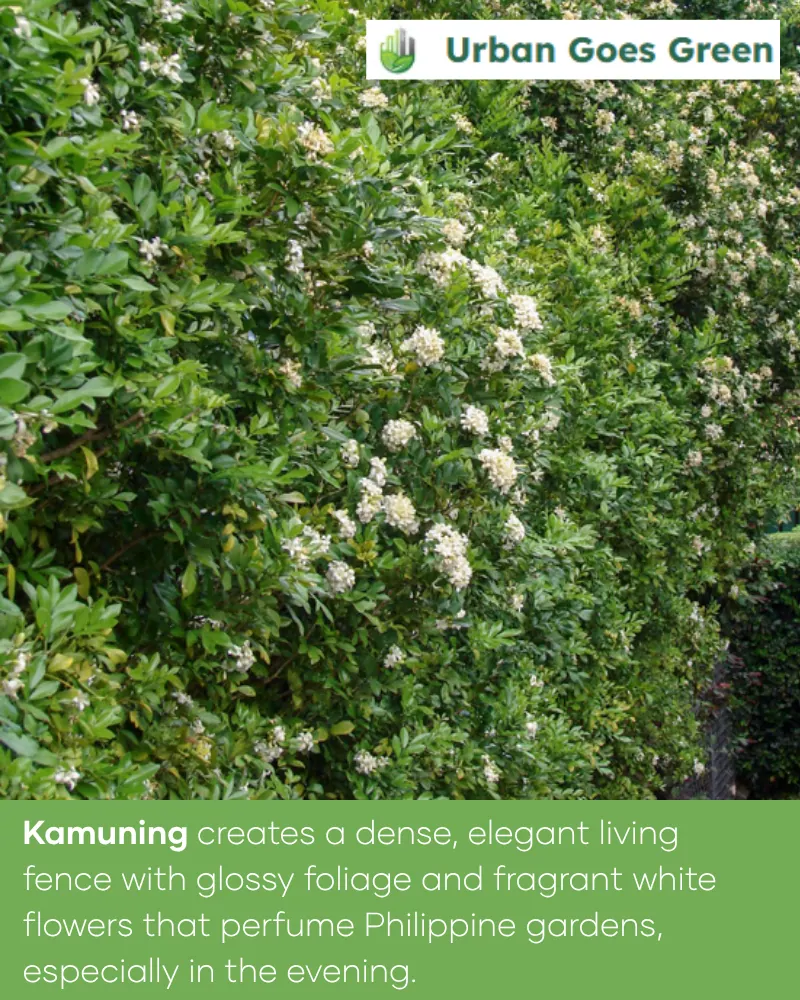
Kamuning, also known as orange jasmine or Chinese box, has been used as a hedge plant in the Philippines for generations. Its dense, fine-textured foliage creates a formal, manicured appearance, and the small white flowers release a sweet fragrance that perfumes the entire garden, especially in the evening.
Growth Characteristics
Kamuning is a moderate grower, adding 30 to 50 cm of height per year. It naturally reaches 3 to 4 metres tall but responds beautifully to pruning and can be maintained at any height from 60 cm to 2.5 metres. The dense branching pattern means it fills in gaps quickly, creating a solid visual barrier within 18 to 24 months.
Spacing
For a formal hedge, plant kamuning at 30 to 45 cm spacing. This tight spacing ensures the hedge fills in completely within one to two growing seasons. For a less formal look with visible individual plants, space them 60 to 75 cm apart.
Soil Requirements
Kamuning thrives in well-drained loam soil enriched with compost. It tolerates a range of soil types, from slightly sandy to clay-heavy, as long as drainage is adequate. If your soil is heavy clay, amend the planting trench with coarse sand and organic matter to improve drainage. Regular feeding with balanced fertiliser every 8 to 10 weeks encourages dense, healthy growth.
Cost
Kamuning seedlings in small pots cost ₱20 to ₱50 each. Medium-sized plants (30 to 45 cm tall) run ₱80 to ₱150. For a tight 10-metre hedge at 40 cm spacing, you need 25 plants, costing ₱500 to ₱3,750 total.
Santan (Ixora): The Flowering Low Hedge
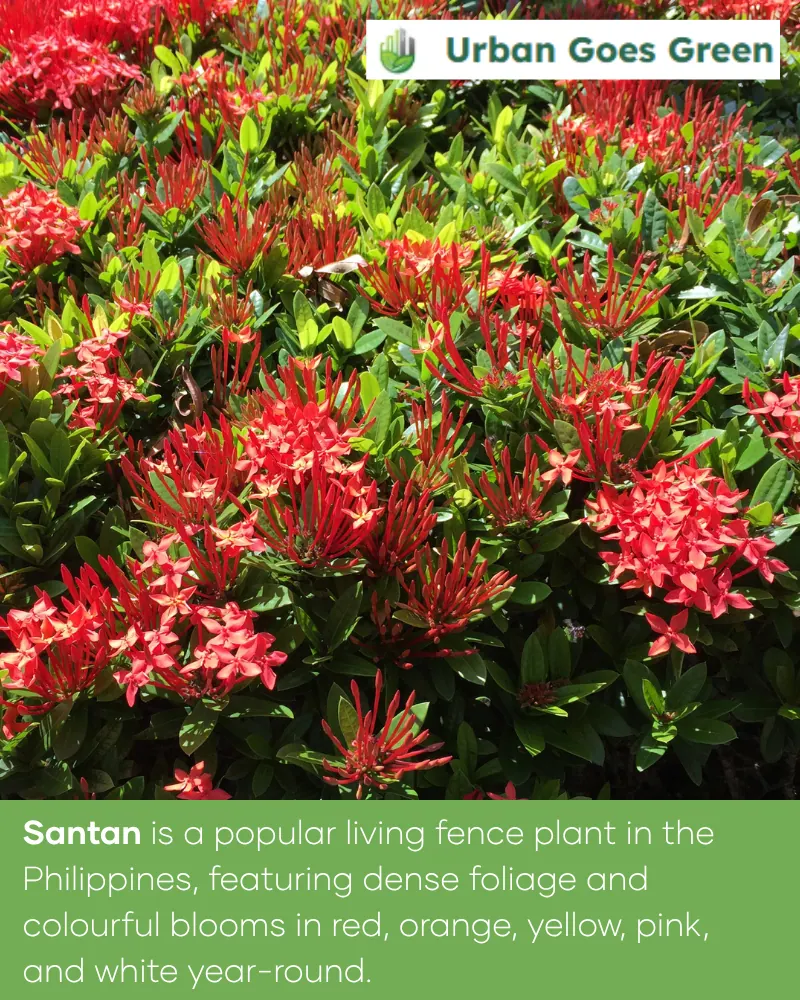
Santan is one of the most commonly seen hedge plants across the Philippines. You will find it bordering driveways, lining walkways, and defining garden borders in neighbourhoods from Baguio to Zamboanga. Its clusters of tiny, star-shaped flowers appear almost continuously throughout the year, providing reliable colour in red, orange, yellow, pink, and white.
Growth and Size
Santan is a slow to moderate grower, typically adding 20 to 30 cm per year. Most varieties reach a mature height of 1 to 1.5 metres, making santan ideal for low borders and garden edging rather than tall privacy screens. Dwarf varieties stay compact at 40 to 60 cm and are perfect for formal garden borders.
Spacing
Plant santan at 25 to 35 cm intervals for a dense, low hedge. For taller varieties used as a medium hedge, increase spacing to 40 to 50 cm.
Maintenance
Santan is remarkably low-maintenance once established. It tolerates both full sun and partial shade, although flowering is heavier in sunny positions. Prune lightly every 2 to 3 months to maintain shape and remove spent flower clusters. Santan prefers slightly acidic soil, so avoid using lime or alkaline amendments near the planting area.
Cost
Santan is one of the most affordable hedge plants available. Small pots cost just ₱15 to ₱35, and larger specimens run ₱50 to ₱100. A 10-metre border at 30 cm spacing requires about 33 plants, totalling ₱495 to ₱3,300.
Duranta: The Versatile Golden Hedge
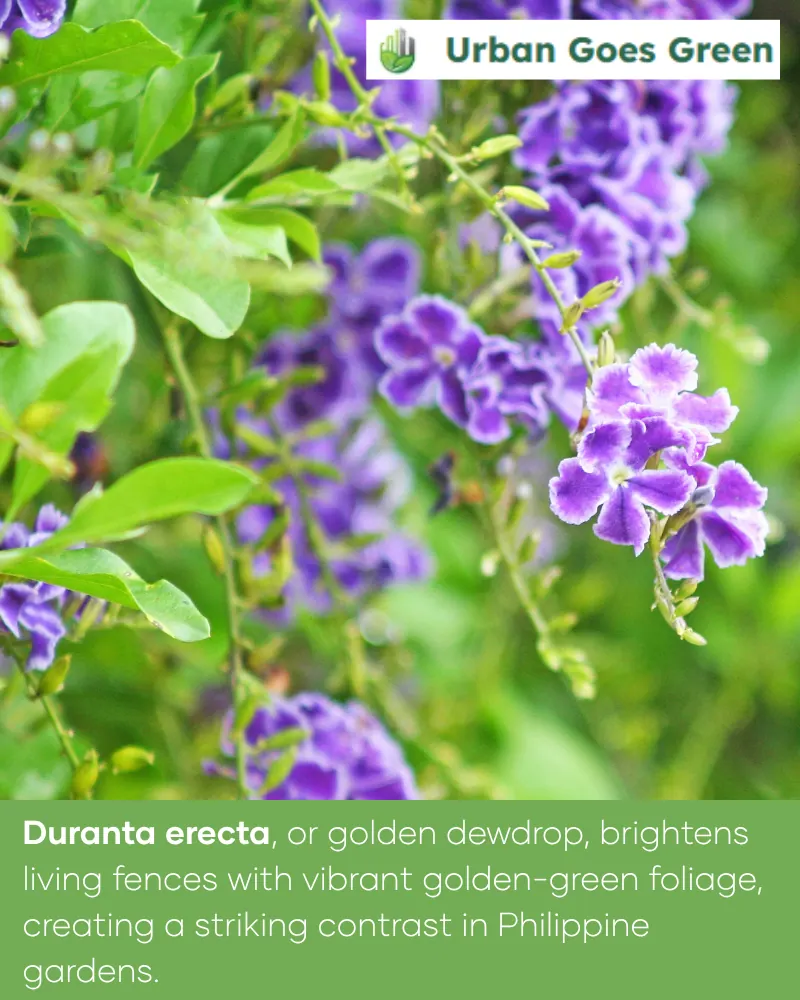
Duranta erecta, commonly called golden dewdrop or pigeon berry, is prized for its bright golden-green or variegated foliage. The variety "Duranta Gold" is especially popular in Philippine landscaping for its striking yellow-green leaves that glow in sunlight, creating a vibrant contrast against darker garden backgrounds.
Growth Rate
Duranta grows moderately fast, adding 40 to 60 cm per year under good conditions. It can reach 2 to 3 metres tall if left unpruned, but it is most commonly maintained as a hedge of 1 to 2 metres. The plant responds exceptionally well to shearing and can be shaped into formal geometric forms with ease.
Spacing and Planting
Plant duranta at 30 to 45 cm spacing for a solid hedge. Prepare a planting trench 30 cm wide and 30 cm deep, filled with a mixture of loam soil, compost, and a handful of complete fertiliser per linear metre. Water deeply after planting and maintain consistent moisture for the first 4 to 6 weeks.
Pruning
Duranta can be pruned every 3 to 4 weeks during the wet season when growth is most vigorous. Use hedge shears for a formal look or hand pruners for a more natural shape. The plant responds to hard pruning by producing multiple new shoots, so do not hesitate to cut back severely if the hedge becomes leggy or sparse at the base.
Cost
Duranta is very affordable. Small pots cost ₱15 to ₱40, and medium plants run ₱50 to ₱120. For a 10-metre hedge at 40 cm spacing, budget for 25 plants at a total cost of ₱375 to ₱3,000.
Need Quality Soil for Your Living Fence?
Premium loam soil delivered same-day across Metro Manila via Lalamove. Starting at just ₱75 per pack.
Podocarpus: The Elegant Formal Hedge
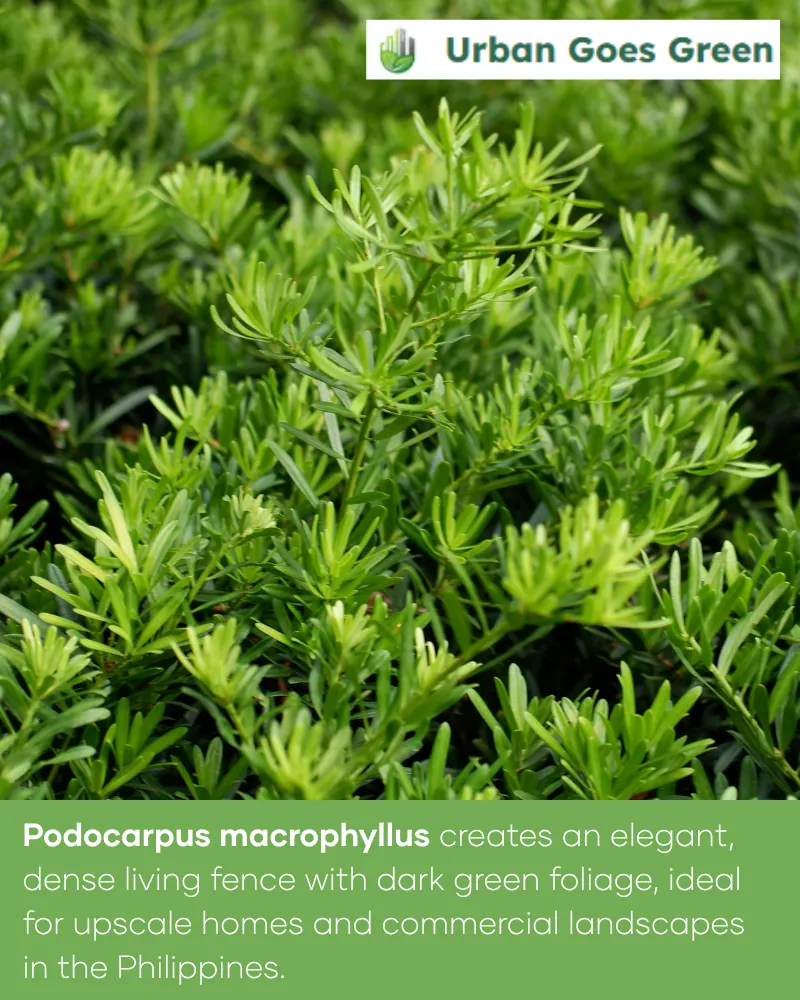
Podocarpus macrophyllus, known as the Buddhist pine or yew pine, is a premium hedge plant that delivers a refined, sophisticated look. Its narrow, dark green leaves grow densely along upright branches, creating a naturally columnar shape that requires minimal training. Podocarpus is the go-to choice for high-end residential developments and commercial properties throughout Metro Manila.
Growth Characteristics
Podocarpus is a slow to moderate grower, adding 20 to 40 cm per year. It can eventually reach 6 to 8 metres tall in its natural form, but when maintained as a hedge, it is typically kept at 1.5 to 3 metres. The slow growth rate means less frequent pruning, but it also means you need to be patient while the hedge fills in.
Spacing
For a dense formal hedge, plant podocarpus at 45 to 60 cm intervals. Because the plant is relatively narrow in its natural growth habit, tighter spacing is sometimes used (30 to 40 cm) for faster fill-in, though this increases your upfront plant cost significantly.
Light and Soil
Podocarpus tolerates both full sun and partial shade, making it adaptable to various garden positions. It prefers well-drained, slightly acidic soil rich in organic matter. Avoid planting in waterlogged areas, as podocarpus is susceptible to root rot in persistently wet conditions. A layer of mulch around the base helps retain moisture while keeping roots cool.
Cost
Podocarpus is one of the more expensive hedge options. Small seedlings (15 to 25 cm) cost ₱80 to ₱150, while established plants (60 to 90 cm) range from ₱350 to ₱800. For a 10-metre hedge at 50 cm spacing, you need 20 plants, with total cost ranging from ₱1,600 to ₱16,000 depending on plant size.
Ficus Varieties: Dense and Fast-Growing
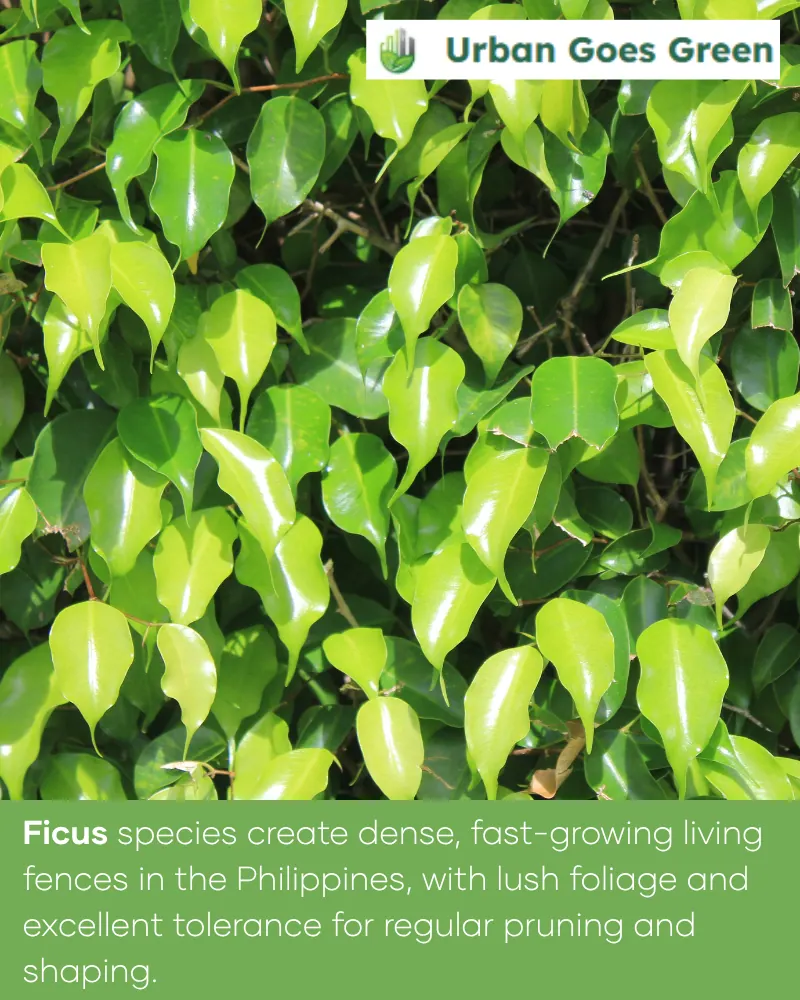
Several ficus species make outstanding living fence plants in the Philippines. Their dense foliage, rapid growth, and tolerance of heavy pruning have made them staples in landscaping projects across the country. The most popular varieties for hedging include Ficus benjamina (weeping fig), Ficus microcarpa (Chinese banyan), and Ficus elastica (rubber tree).
Ficus Benjamina
This is the most commonly used ficus for hedging. It grows quickly (50 to 80 cm per year), produces dense, drooping branches with small, glossy leaves, and tolerates heavy shearing. Plant at 45 to 60 cm spacing. Small plants cost ₱30 to ₱80, and medium-sized plants run ₱100 to ₱250.
Ficus Microcarpa
Chinese banyan is slightly more vigorous than benjamina and develops aerial roots that add visual interest. It is excellent for topiary and formal hedges. Plant at 50 to 70 cm spacing. Expect similar pricing to ficus benjamina, with small plants at ₱40 to ₱100.
Important Consideration
Ficus species develop aggressive root systems that can damage foundations, pipes, and paved surfaces if planted too close to structures. Maintain at least 2 metres of distance from any building foundation or underground utility line. Install root barriers if space is limited. For more tips on managing plants in tight urban spaces, see our guide to container gardening in the Philippines.
Alagaw (Premna odorata): The Native Aromatic Fence
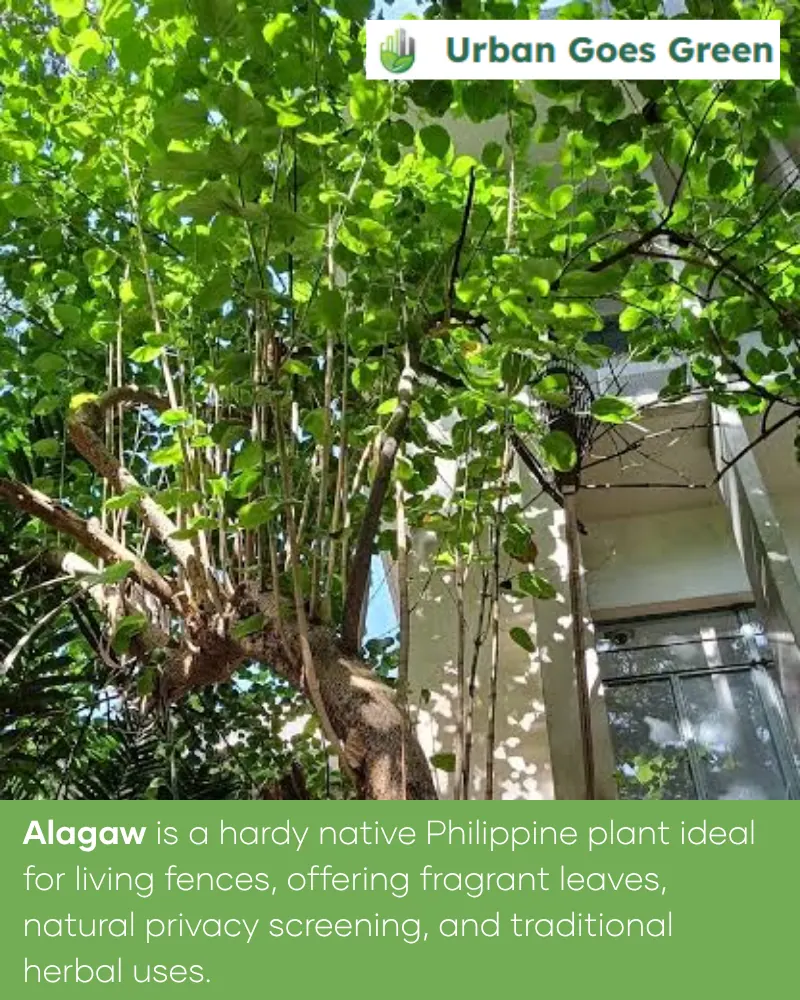
Alagaw is a native Philippine tree that has gained renewed interest as a living fence plant thanks to its fragrant leaves, hardiness, and cultural significance. Traditionally used in folk medicine, alagaw produces small, aromatic leaves that release a pleasant scent when brushed or crushed. The plant is also valued in the herbal industry, so growing an alagaw hedge can serve dual purposes of privacy screening and leaf harvesting.
Growth and Size
Alagaw is a moderate to fast grower, adding 40 to 70 cm per year. Left unpruned, it can reach 4 to 6 metres, but it responds well to pruning and can be maintained as a hedge of 1.5 to 2.5 metres. The branching pattern becomes denser with regular pruning, creating an effective visual barrier.
Spacing
Plant alagaw at 50 to 75 cm intervals. The plant naturally develops a spreading canopy, so wider spacing still results in good hedge coverage within 12 to 18 months.
Cost
Alagaw seedlings are moderately priced at ₱40 to ₱100 for small plants. Medium specimens (45 to 60 cm) cost ₱120 to ₱250. For a 10-metre fence at 60 cm spacing, you need about 17 plants, totalling ₱680 to ₱4,250.
Pandakaki (Tabernaemontana pandacaqui): The Fragrant Flowering Fence
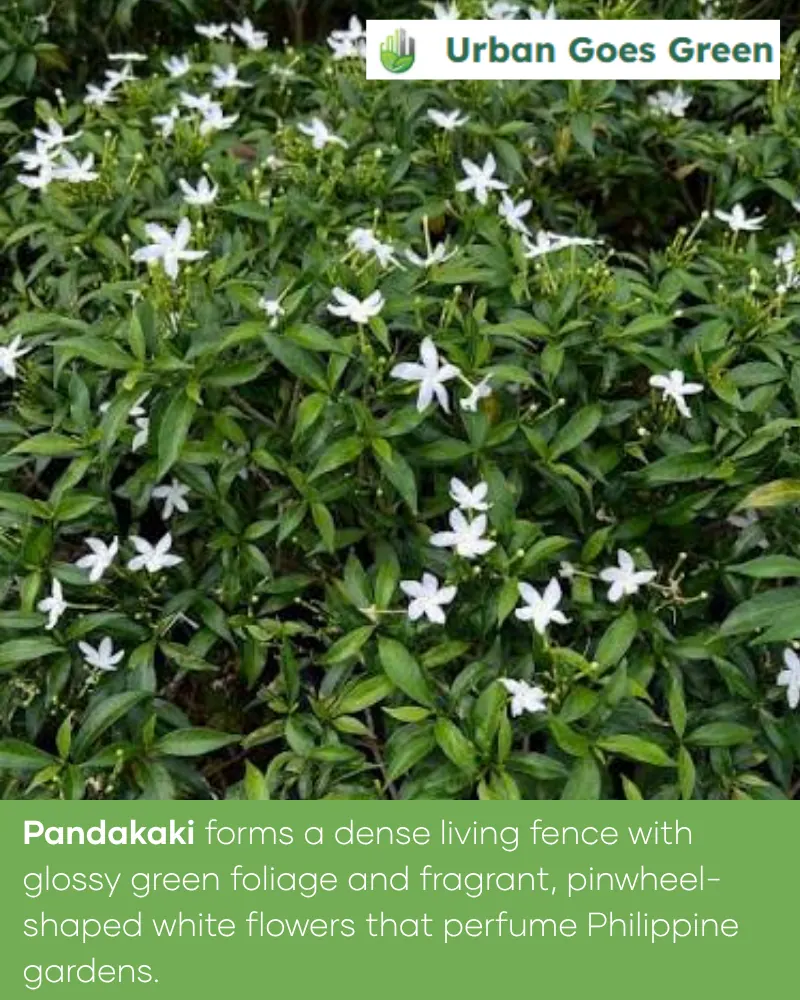
Pandakaki is another excellent native Philippine plant for living fences. It produces clusters of white, pinwheel-shaped flowers with a sweet jasmine-like fragrance that intensifies in the evening. The glossy, dark green foliage stays attractive year-round, and the plant naturally forms a dense, rounded shape that requires minimal shaping.
Growth Characteristics
Pandakaki grows at a moderate pace, adding 25 to 45 cm per year. Mature plants reach 2 to 3 metres in height, making them suitable for medium-height privacy hedges. The branching is naturally dense, and the plant produces new growth from the base, which helps prevent the bare-legged look that some hedge plants develop over time.
Spacing and Care
Plant pandakaki at 40 to 60 cm intervals. It prefers partial shade to full sun, making it an excellent choice for east-facing boundaries or areas that receive morning sun and afternoon shade. Water regularly during the first dry season after planting, then reduce watering once the plants are established. Pandakaki tolerates a range of soil types but performs best in rich, well-drained loam.
Cost
Pandakaki seedlings in small pots cost ₱30 to ₱70. Medium plants (30 to 50 cm) range from ₱100 to ₱200. For a 10-metre hedge at 50 cm spacing, budget for 20 plants at ₱600 to ₱4,000 total.
Madre de Cacao (Gliricidia sepium): The Zero-Cost Fence
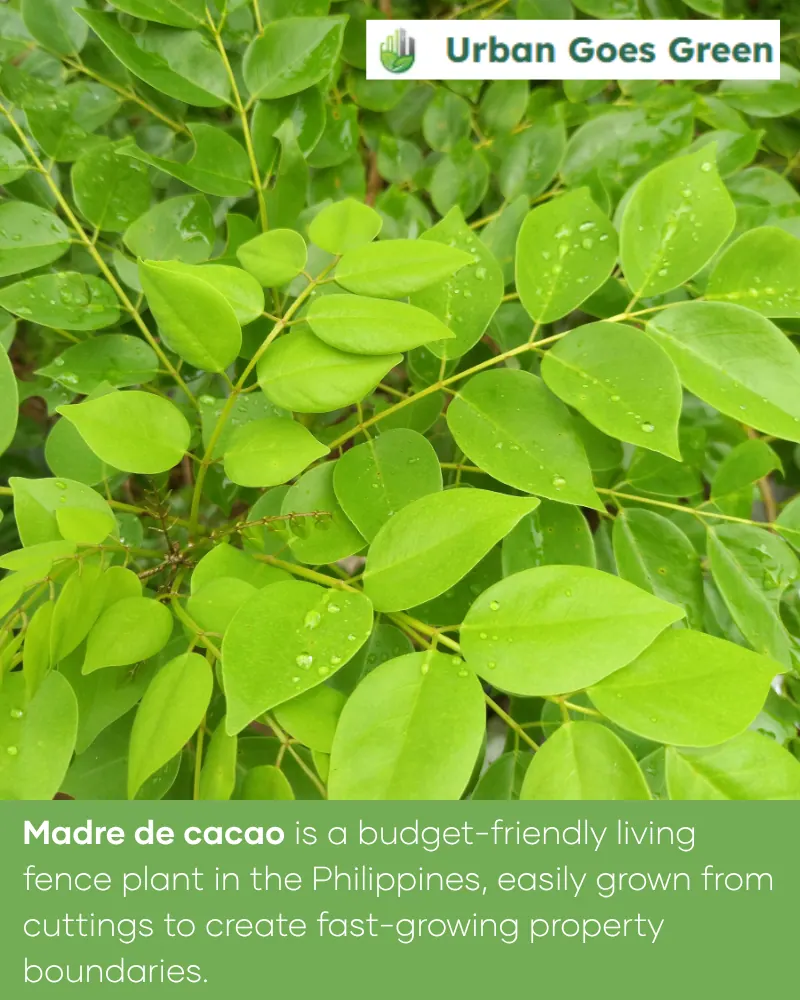
Madre de cacao is the undisputed champion of budget-friendly living fences in the Philippines. This fast-growing leguminous tree can be propagated from stem cuttings with virtually no expense. In rural areas, entire property boundaries are fenced with madre de cacao stakes that root directly in the soil, creating a living fence within a single wet season.
Propagation
The easiest way to establish a madre de cacao fence is to cut mature stems or branches (2 to 3 cm diameter, 1.5 to 2 metres long) and plant them directly into the ground during the onset of the rainy season. Bury the bottom 30 to 40 cm of each stake in the soil. The cuttings will develop roots and leaf out within 2 to 4 weeks. Success rates are typically 80% to 95% during the wet season.
Spacing
For a dense fence, plant cuttings at 25 to 30 cm intervals. For a more open fence line that will be interplanted with climbing vines or lower hedge plants, space them 50 to 75 cm apart. The rapid growth means even widely spaced plants will form a continuous canopy within one year. With a sturdy frame and some shade, the native tayabak (jade vine) is a striking climber to train along it.
Additional Benefits
Madre de cacao is a nitrogen-fixing plant, meaning it enriches the soil around it through a symbiotic relationship with soil bacteria. The leaves make excellent green mulch and compost material. The tree also produces pink to lavender flowers that attract bees and butterflies. In some areas, the wood is used for charcoal production and the leaves are used as a natural insect repellent. For more about soil health and composting, visit our composting guide.
Cost
If you have access to a mature madre de cacao tree, the cost is essentially zero, just the effort of cutting and planting stakes. If purchasing, cuttings cost ₱5 to ₱15 each. A 10-metre fence at 30 cm spacing needs about 33 cuttings, costing a maximum of ₱495. This makes madre de cacao the most affordable living fence option by a wide margin.
Thorny Plants for Security Fencing
If deterring intruders is a primary concern, several thorny and spiny plants serve as highly effective natural security barriers. These plants combine the aesthetic benefits of a living fence with the practical deterrent value of painful thorns.
Bougainvillea (Revisited)
As discussed earlier, bougainvillea's sharp thorns make it the most popular dual-purpose living fence plant, offering both beauty and security. A mature bougainvillea hedge is as effective a deterrent as barbed wire, but far more attractive.
Crown of Thorns (Euphorbia milii)
This succulent plant produces dense clusters of sharp thorns along thick stems. It flowers continuously in red, pink, yellow, or white. Plant at 20 to 30 cm spacing for a low security border. Small plants cost ₱20 to ₱60 each. The milky sap can irritate skin, so handle with gloves.
Natal Plum (Carissa macrocarpa)
Natal plum features forked thorns that make it extremely difficult to penetrate. It produces fragrant white flowers and edible red fruits. Plant at 40 to 60 cm spacing. Seedlings cost ₱60 to ₱150. This is an excellent choice for properties that face public areas where security is a concern.
Kalachuchi with Thorny Undergrowth
While kalachuchi (plumeria) itself is not thorny, it can be combined with thorny ground-level plants to create a layered security fence. Plant tall kalachuchi for upper screening and fill the base with crown of thorns or bougainvillea for a security barrier that remains attractive from every angle.
Cost Per Linear Metre Comparison
Understanding the cost per linear metre helps you budget accurately for your living fence project. Here is a comprehensive comparison of all the plants discussed in this guide, calculated for a standard hedge using medium-sized plants at recommended spacing.
Budget options (under ₱100 per linear metre):
- Madre de cacao: ₱15 to ₱50 per linear metre
- Santan: ₱50 to ₱100 per linear metre
- Duranta: ₱40 to ₱85 per linear metre
Mid-range options (₱100 to ₱300 per linear metre):
- Bougainvillea: ₱100 to ₱300 per linear metre
- Kamuning: ₱100 to ₱250 per linear metre
- Alagaw: ₱100 to ₱200 per linear metre
- Pandakaki: ₱100 to ₱250 per linear metre
- Ficus benjamina: ₱80 to ₱200 per linear metre
Premium options (₱300+ per linear metre):
- Podocarpus: ₱300 to ₱800 per linear metre
- Bamboo (established clumps): ₱200 to ₱550 per linear metre
These prices cover plants only. Add ₱30 to ₱75 per linear metre for quality loam soil and compost to fill the planting trench. If you need to hire labour for planting, budget an additional ₱100 to ₱200 per linear metre depending on your location and the complexity of the site preparation. For a full budget breakdown of garden projects, see our garden budget planner.
Planting and Soil Preparation Tips
Proper soil preparation is the single most important factor in establishing a successful living fence. Skimping on soil quality leads to slow growth, poor coverage, and gaps in the hedge that can take years to fill in.
Preparing the Planting Trench
Rather than digging individual holes, dig a continuous trench along your fence line. Make the trench 30 to 40 cm wide and 30 to 40 cm deep. Remove any rocks, construction debris, and weed roots. If the existing soil is heavy clay, remove it entirely and replace with a mix of 60% quality loam soil, 30% compost, and 10% coarse sand or rice hull.
Soil Selection
Most hedge plants perform best in loam soil, which provides a balanced combination of drainage, moisture retention, and nutrient-holding capacity. Avoid using pure garden soil or topsoil from construction sites, as these often contain too much clay or sand. Premium loam soil is available for delivery across Metro Manila, ensuring your living fence gets the best possible start.
Planting Timing
The ideal time to plant a living fence in the Philippines is at the start of the wet season, typically late May to early June. Planting during this period takes advantage of natural rainfall to establish root systems without the need for constant manual watering. Avoid planting during the hottest months of March to early May, as intense heat stress can kill newly transplanted seedlings.
Watering Schedule
Water newly planted hedges daily for the first 2 weeks, then every other day for the next 4 weeks. After 6 weeks, most hedge plants have established enough root growth to survive on rainfall alone during the wet season. During the dry season (November to May), water established hedges deeply once or twice a week rather than giving shallow daily waterings.
Fertiliser Application
Apply complete fertiliser (14-14-14) at a rate of one tablespoon per plant every 6 to 8 weeks during the growing season. Alternatively, side-dress with well-decomposed compost or vermicast every 2 to 3 months. Avoid over-fertilising, which can cause excessive soft growth that is vulnerable to pests and diseases. For guidance on building your own compost, explore our composting guide.
Pruning Schedules for Living Fences
Regular pruning is essential for maintaining a dense, attractive living fence. Without pruning, most hedge plants become leggy at the base and top-heavy, losing their effectiveness as a privacy screen or boundary marker.
General Pruning Principles
Always prune hedges so that the top is slightly narrower than the base. This tapered profile ensures that sunlight reaches the lower branches, preventing the bare-legged look that ruins many hedges. A good rule of thumb is to make the top 5 to 10 cm narrower on each side compared to the base.
Monthly Pruning Plants
Duranta, ficus, and bougainvillea are vigorous growers that benefit from monthly light pruning during the wet season. This frequency keeps the hedge compact and encourages dense branching throughout the plant, not just at the tips.
Bi-monthly Pruning Plants
Kamuning, santan, and pandakaki grow at a moderate pace and need pruning every 6 to 8 weeks. Focus on maintaining an even surface and removing any branches that grow significantly beyond the desired hedge profile.
Quarterly Pruning Plants
Podocarpus, bamboo, and alagaw are slower growers that need pruning only 3 to 4 times per year. Bamboo pruning involves removing old or damaged culms at ground level and trimming side branches for a tidy appearance.
Tools Needed
Keep your pruning tools sharp and clean to make precise cuts that heal quickly. Essential tools for hedge maintenance include hand pruners for stems up to 2 cm diameter, hedge shears for formal shaping, loppers for thicker branches, and a small pruning saw for bamboo culms. Disinfect tools with rubbing alcohol between plants to prevent spreading diseases. For a complete guide to building your toolkit, read our article on essential gardening tools.
Frequently Asked Questions
How long does it take for a living fence to fully grow in the Philippines?
The time it takes for a living fence to reach full coverage depends on the species you choose. Fast-growing plants like madre de cacao and bamboo can form a dense screen within 6 to 12 months when planted at the correct spacing. Medium-growers such as duranta and santan typically need 12 to 18 months to create a solid hedge. Slower species like podocarpus and kamuning may take 2 to 3 years to reach their full potential. You can speed up growth by preparing the planting trench with quality loam soil, watering consistently during the first dry season, and applying organic fertiliser every 6 to 8 weeks.
What is the cheapest living fence plant in the Philippines?
Madre de cacao (Gliricidia sepium) is widely considered the most affordable living fence option in the Philippines. You can propagate it from stem cuttings at virtually no cost, since mature branches root easily when stuck directly into moist soil. If you purchase cuttings, they typically cost just ₱5 to ₱15 each. Santan and duranta are also budget-friendly, with small pots priced between ₱15 and ₱35 at local nurseries. For a 10-metre fence line using madre de cacao planted at 30 cm spacing, you would need roughly 33 cuttings, bringing the total plant cost to under ₱500.
Can I mix different plants in one living fence?
Yes, mixing different species in a single living fence is a popular approach in Philippine landscaping. A well-planned mixed hedge can provide year-round colour, varied textures, and layered privacy screening. One effective combination is to plant tall bamboo or madre de cacao as the back row, medium-height kamuning or duranta as the middle layer, and low-growing santan or bougainvillea at the front. When mixing species, group plants with similar water and sunlight needs together. Keep in mind that aggressive growers like bamboo may need root barriers to prevent them from overtaking neighbouring plants.
Related Guides
Urban Gardening in the Philippines
Your complete beginner's guide to growing plants in urban spaces.
Getting StartedGarden Budget Planner Philippines
How to plan and budget for your garden project at every price point.
Container GardeningContainer Gardening in the Philippines
Grow food and flowers in pots, planters, and recycled containers.
ToolsEssential Gardening Tools Guide
Every tool you need to start and maintain a thriving garden.