
Co-Founder, Urban Goes Green
Joe VillalobosBuilding a greener city, one bag of soil at a time.
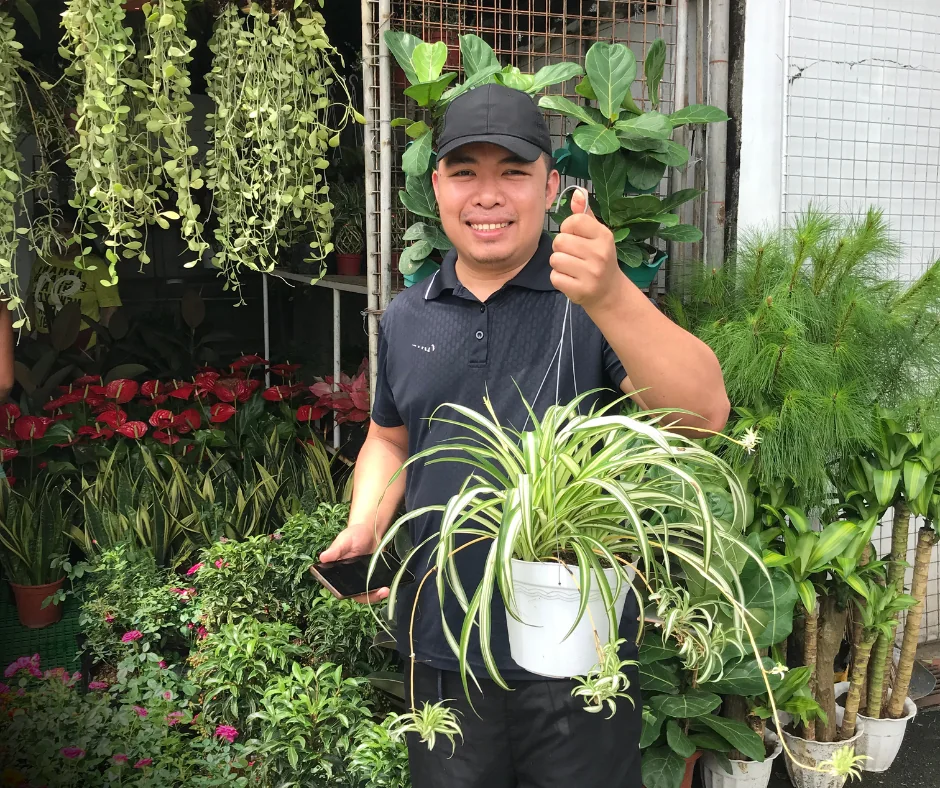
I co-founded Urban Goes Green because too many people in Metro Manila want to start gardening and cannot find anywhere nearby to buy decent soil. I also build and run the search marketing behind it, which means this business doubles as the case study for the work I do professionally.
Why we started
The goal was never to sell loam soil.
Selling soil is how we keep the lights on. Helping people actually begin is the reason the business exists.
Most people believe gardening is difficult, expensive, or something you need a big garden for. None of that is true, and those three beliefs stop more Filipinos from planting than any real obstacle does. Everything we do is aimed at removing them.
If someone buys one bag of loam soil and one small plant, that already counts as a win to us. Nobody learns gardening by reading about it. You learn it by watering something, losing a few plants, and trying again. What people need is not a perfect plan. They need a reachable place to start.
We keep our margins deliberately modest because the long-term goal is bigger than the monthly revenue. We want more families gardening together, more children curious about how food grows, more schools able to get materials without a special trip across the city, and more streets with something green on them. If more people plant because Urban Goes Green exists, the business is doing its job.
The gap we saw
In parts of Metro Manila you can count the soil suppliers on one hand.
Pasig is a good example. So is Manila. These are dense, populated cities where thousands of people would happily keep plants, and the number of places selling proper loam soil, garden soil and pots is small enough to list from memory. People end up ordering blind online, settling for whatever the hardware store has, or travelling to Bulacan and back for one delivery.
That is a supply problem, not a demand problem. The interest is already there. What is missing is somebody nearby who answers the phone, knows what the soil is actually for, and can get it to you this week.
Most people who never start gardening did not decide against it. They just could not find anywhere close by to buy the soil.
Joe Villalobos, co-founderHow we work
Most garden stores close at six. Most customers are only free after seven.
So we try to be reachable when people actually need us, which is usually the least convenient time.
How we judge whether it is working
Revenue matters, because a business that does not survive helps nobody. But it is not the only number I look at. I also want to know how many people started gardening this month who were not gardening last month, how many families got interested, how many children learned something, how many streets look greener, and how many customers came back because we did right by them the first time. Those are harder to chart and they matter just as much.
The path so far
From one branch in Sampaloc to six across Metro Manila.
Urban Goes Green started in Sampaloc, Manila in 2021. Everything since has been the same loop repeated: find where people cannot get supplies, get closer to them, then write down what we learned so the next person does not have to ask.
Chapter 01 · 2021
A single branch in Sampaloc, Manila
Loam soil, garden soil, a small range of plants, and a delivery van. Almost every early order came from someone who had been searching for a supplier nearby and could not find one.
Chapter 02
Deliveries spread across the metro
Word of mouth carried us into Quezon City, Pasig and Caloocan. The pattern in the messages was consistent enough to act on: people were not short of interest, they were short of a nearby supplier.
Chapter 03
More branches, each closer to a cluster of customers
Araneta Cubao, Mindanao Avenue, Pasig and Novaliches followed. Every location was picked to shorten somebody's trip, not to chase a nicer address.
Chapter 04 · May 2026
The website gets rebuilt and the migration completes
The old site had roughly seven pages on a traditional CMS. I rebuilt it as a modern static site with an automated publishing pipeline, and finished the move in the middle of May 2026. That decision is what made everything after it possible, and it is the point where the Search Console graph changes direction.
Chapter 05 · Mid 2026
The content engine
Plant guides, gardening articles, tool and machinery guides, branch pages, a soil calculator. Because publishing was now a build step rather than an afternoon of admin work, the library grew to 448 plant guides and more than 300 articles in a matter of months. The goal was to answer the question before somebody has to message us to ask it.
Chapter 06 · September 2026
Five branches, hundreds of guides, and a business that teaches
The shop funds the guides. The guides bring in the people who need the shop. Neither half works as well without the other, and that loop is the whole strategy.
The other half of the job
I am also an SEO and digital marketing specialist.
This is not a side note. It is the reason Urban Goes Green reaches the people it reaches. I have spent years doing search work for other companies, and everything I recommend to a client gets built here first. When something works on this site, I know it works, because I watched it happen on a business I am personally responsible for.
I am not putting this on the page to boast. I want visitors to understand that none of what follows was an accident. The site architecture, the branch pages, the Google Business Profile, the internal linking, the content plan, the page speed work, the automation behind the publishing. All of it was a decision, and all of it is measurable.
Selected work
Brands and teams I have worked with.
Across education, property, careers and healthcare, in Singapore, the Philippines, Australia and the United States. Mostly search, content architecture and the technical work that makes both of those pay off.
Names are listed as engagements, past and present. Logos and trademarks belong to their respective owners and appear here to identify the organisation, not to imply endorsement.
Local search
A website brings readers. A Google Business Profile brings phone calls.
For a business with physical branches, the profile is often the first thing a customer sees and the only thing they act on. Someone searching for garden soil near them is not browsing. They want a phone number, a set of directions and a reason to trust you before they get in the car.
Optimising the profile properly means categories, services, products, photos, posts, hours, the questions people ask, reviews, and keeping every branch consistent with what the website says. It is unglamorous work, and it produces the most direct results of anything on this page. Calls doubled year on year, and so did clicks through to the website. Direction requests grew more modestly, which makes sense: people were already finding the branches, they just had fewer reasons to ring first.
April to August 2026, against the same five months a year earlier
Source: Google Business Profile performance reporting for Urban Goes Green, April to August 2026 against April to August 2025. Calls, direction requests and website clicks are the three components of the total, so the first three rows add up to the fourth.
The receipts
Do not take my word for any of it.
Every number on this page came out of one of these seven dashboards. Unedited screens from Google Search Console, the Google Business Profile and Google Analytics, with the date ranges left visible so you can check the periods against the claims. Select any panel to read it full size.
What I want you to take away
No single piece of this works on its own.
This is the part most businesses get wrong, and it is worth saying plainly. A website on its own will not do it. A Google Business Profile on its own will not do it. Neither will local SEO by itself, or content by itself. Each one produces a small, disappointing result and everybody concludes that search does not work for their industry.
What actually changes the outcome is the whole set moving together. The site is fast and structured properly, so the content it holds can rank. The content answers real questions, so it earns links, trust and repeat visits. The technical work makes sure the crawler sees all of it. The Business Profile turns local intent into phone calls. Entity signals tie the brand, the person and the branches together so Google understands who you are across the web. Reviews confirm to a human what the rankings suggested. Urban Goes Green is the proof, and the numbers above are what it looks like when the pieces reinforce each other.
Questions
The things people ask most.
Loam soil and garden soil by the sack or by bulk delivery, organic fertiliser, vermicast and compost, grow kits, hydroponic supplies, grass for lawns, pots, and a rotating range of ornamental and edible plants. We also take on landscaping and grass installation work. If you are not sure what you need, message us and describe the space. We will tell you honestly, including when the answer is less than you thought.
Yes. We deliver across Metro Manila from five branches, which is the whole reason we opened more than one. Delivery cost depends on distance and volume, so the fastest way to get a straight answer is to tell us your barangay and roughly how many sacks you need.
We try, and often we can. It depends on the branch, the stock and the night. We will not promise something we cannot deliver, but if you message late because a school project is due tomorrow, tell us. Sorting that out is one of the more satisfying parts of this job.
Completely free, with no sign-up. There are hundreds of them covering ornamental plants, edible plants, tools and machinery, plus a soil calculator that works out how much you need. Use them even if you buy your supplies somewhere else. That is what they are for.
Yes, on a limited basis. The work is search focused: local SEO and Google Business Profile, technical SEO and site performance, content architecture, and automation to keep publishing sustainable. The fastest way to see how I work is to read this page, then get in touch and tell me what you are trying to grow.
Because claims are cheap and screenshots of somebody else's account prove nothing. Urban Goes Green is a real business with a real address, real branches and a real phone number, so its numbers can be checked against something you can walk into. If the approach did not work, this page would be very difficult to write.
Work with me
Tell me about your business.
Local SEO, website automation with SEO, hosting and more. Pick what you need help with and a day that suits you, and we can go through your business plan together.